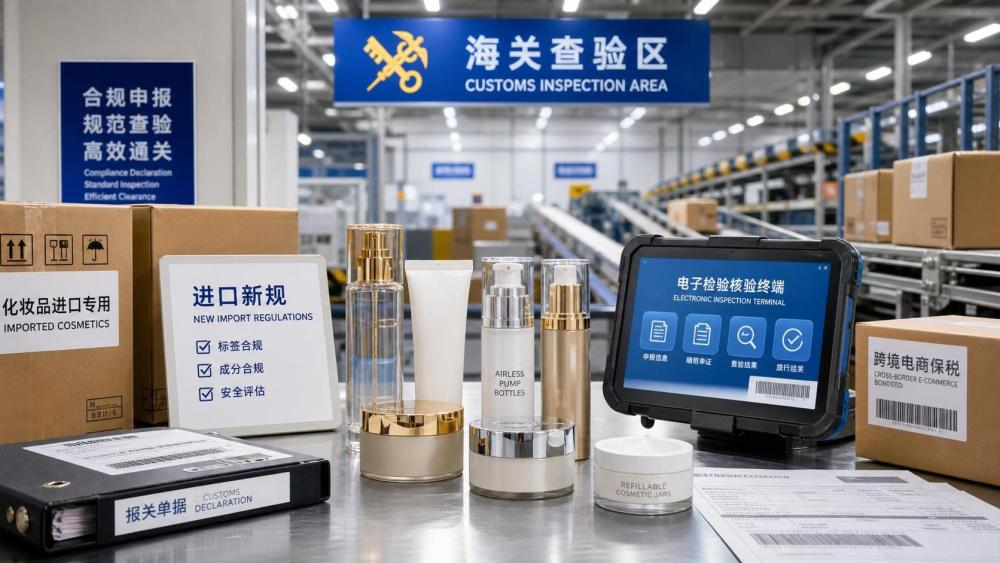
On December 1, 2026, a revised rule for cosmetics import and export inspection and quarantine takes effect under General Administration of Customs Order No. 284, replacing the previous Order No. 143. The change matters because it removes mandatory filing requirements for import consignees and export manufacturers, shifts import inspection to the declared destination, and moves registration and filing verification into a fully electronic process. For importers, brand owners, distributors, and supply chain partners, the update is worth close attention because it directly touches customs handling speed, compliance workload, and delivery responsiveness in cross-border beauty trade.
What the new rule formally changes
According to the information provided, General Administration of Customs Order No. 284 was issued on May 6, 2026, and the new Measures for the Supervision and Administration of Inspection and Quarantine of Import and Export Cosmetics will be implemented on December 1, 2026.
The new measures will fully replace the previous Order No. 143. The confirmed changes include the cancellation of mandatory filing for import consignees and export manufacturing enterprises, the adoption of destination-based inspection for declared imports together with one-time inspection at the place of production, and fully electronic verification for registration and filing.
The same information also indicates that these adjustments directly affect customs clearance efficiency, compliance costs, and supply chain response speed for global importers, brand owners, and distributors, with particular relevance for cross-border beauty brands using higher-end packaging such as Refillable Cosmetic Jars and Airless Pump Bottles.
Where the operational effects are likely to appear first
Customs-facing import workflows may become more document-focused
From an industry perspective, importers and direct trading companies are likely to feel the change first because their daily operations sit closest to consignee filing, inspection handling, and customs document coordination. With mandatory consignee filing removed and verification handled electronically, the practical focus may shift toward the completeness and consistency of registration, filing, and shipment documents rather than legacy filing routines.
Brand owners and distributors need to watch delivery coordination
Analysis shows that brand owners and distribution businesses may see the impact mainly in delivery planning, product launch timing, and cross-border replenishment arrangements. The move to inspection at the declared destination can affect how brands sequence arrival, warehousing, and downstream handover, especially when supply chains are built around premium cosmetic packaging formats that often require tighter delivery coordination.
Packaging-linked cross-border programs could benefit from faster response
Observably, the rule update is especially relevant for cross-border beauty brands using Refillable Cosmetic Jars and Airless Pump Bottles. The confirmed information does not establish a guaranteed outcome, but it does indicate that the policy change is favorable for businesses that depend on smoother clearance, lower compliance friction, and faster supply chain response when managing higher-end packaging programs.
Service providers will need to align around electronic verification
Supply chain service providers, compliance support teams, and testing-related service participants may need to pay closer attention to how electronic verification is applied in practice. What deserves closer attention is not only the policy text itself, but also how document review, submission readiness, and shipment support processes are adjusted around a fully digital verification path.
What companies should monitor before treating this as routine practice
Review document sets against the new verification logic
Analysis shows that companies should first review whether their current import, export, and product files are organized for electronic verification rather than older filing-dependent routines. This is particularly relevant for registration or filing-related records, shipment support documents, and internal handoff procedures between trade, compliance, and logistics teams.
Track the operational meaning of destination inspection
What deserves closer attention is how destination-based inspection will be reflected in day-to-day execution. The provided information confirms the rule change, but it does not provide detailed operating procedures in this prompt. Companies therefore need to keep watching for official wording, execution criteria, and any practical interpretation that could affect delivery scheduling, handover timing, or warehouse planning.
Check supplier readiness for the post-filing environment
From an industry perspective, firms working with overseas manufacturers, packaging suppliers, and distribution partners should confirm whether counterparties understand the removal of mandatory filing requirements and the shift toward electronic verification. This is not the same as assuming the compliance burden disappears; instead, the focus may move toward document quality, traceability, and process coordination.
Pay attention to products tied to premium packaging and cross-border launches
Observably, businesses handling products packaged in Refillable Cosmetic Jars and Airless Pump Bottles may want to reassess procurement timing and launch coordination under the new rule environment. The reason is not that a final execution result is already confirmed, but that the provided information explicitly links the rule change to clearance efficiency, compliance costs, and supply chain responsiveness for these cross-border beauty programs.
Why this looks like a clear execution signal, but not the final word
Analysis shows that this update is more appropriately understood as a rule now entering formal implementation rather than as a tentative policy direction. The implementation date is explicit, and the replacement of the earlier order gives the market a concrete compliance reference point.
At the same time, Observably, the more practical questions now move to execution details: how electronic verification will be applied in routine cases, how destination inspection will be handled in actual workflows, and how market participants adjust their internal documentation and delivery arrangements. That is why the event should be read both as a landed regulatory change and as a continuing operational watchpoint.
How the market should read this update now
At this stage, it is more appropriate to understand the December 1 implementation as a confirmed regulatory shift with direct implications for customs handling, compliance organization, and supply chain timing in cosmetics trade. The strongest immediate takeaway is not a guaranteed outcome for every business, but a clear signal that trade participants should realign internal processes around destination inspection, reduced mandatory filing, and electronic verification.
For the industry, the significance lies in execution readiness. Companies that depend on cross-border cosmetics flows, distributor coordination, and packaging-sensitive launch schedules will need to follow how the rule is applied in practice before treating the new framework as fully settled operating routine.
Basis of this article and what still needs verification
This article is generated on the basis of the user-provided news title, event date, and event summary. The information provided refers to a regulatory update issued under General Administration of Customs Order No. 284, with implementation on December 1, 2026, and describes the replacement of the previous Order No. 143 together with the main procedural changes stated above.
For this type of development, commonly relevant source categories include official notices, publications from regulatory authorities, customs or trade administration releases, industry association updates, standard-setting documents, and reporting by authoritative media. A specific official source link was not provided in the input, so the exact original release path still requires ongoing verification.
Further observation should focus on detailed implementation language, practical compliance interpretation, documentation expectations, procurement and tender document adjustments, market feedback, and how companies execute under the new framework after the effective date.
Recommended News
 Pico-second Laser SystemsHow to Evaluate Commercial Picosecond Lasers for Multi-Service Aesthetic ClinicsCommercial salon lasers picosecond: evaluate wavelengths, skin-type suitability, workflow, safety, and supplier support to choose a profitable multi-service clinic platform.Sep 13, 2026Author:
 FDA Aesthetics & Safety RegsHow to Qualify a Collagen Induction Therapy Supplier for Professional ClinicsChoose a collagen induction therapy supplier with confidence—compare device specs, sterile cartridges, compliance, training, and service to protect clinic performance.Sep 12, 2026Author:
 Refillable Cosmetic JarsWhat a Beauty Packaging Sustainability Report Should Measure Beyond RecyclabilityBeauty packaging sustainability report: explore metrics beyond recyclability, from PCR traceability and product protection to refill performance, transport efficiency, compliance, and credible lifecycle decisions.Sep 11, 2026Author:
 Coanda Air StylersDo Ionic Air-Wrap Styling Tools Reduce Frizz Without Excess Heat?Air-wrap styling tools ionic technology can help reduce frizz, smooth flyaways, and style hair with controlled airflow and less reliance on excess heat. Learn what really works.Sep 10, 2026Author:
 FDA Aesthetics & Safety RegsCE Compliance for Cosmetic Devices: Essential Safety Standards and Technical FilesCosmetic device safety standards CE: learn how classification, risk-based testing, technical files, claims, and change control build credible EU compliance.Sep 09, 2026Author:
 FDA Aesthetics & Safety RegsBuying Salon Equipment in the USA: A Checklist for Safety, Warranty, and ServiceSalon equipment USA buying checklist: verify safety documentation, warranty coverage, local service, installation needs, and total ownership costs before you invest.Sep 09, 2026Author:
 Multi-polar RF Anti-agingHow RF Anti-Aging Technology Uses Controlled Heat for Skin RejuvenationRF anti-aging technology uses controlled heat, smart electrode design, and cooling to support firmer-looking skin. Explore how safe, precise RF rejuvenation works.Sep 07, 2026Author:
 FDA Aesthetics & Safety RegsHow Much Does CE MDR Certification Cost? A Budget Guide for Medical Device CompaniesCE MDR certification cost explained: uncover key budget drivers, hidden lifecycle expenses, and smart planning steps for medical device market entry.Sep 07, 2026Author:
 Ceramic Flat IronsHeat Control in Electric Hair Care Appliances: Accuracy, Sensors, and SafetyElectric hair care appliances heat control: explore temperature accuracy, sensor placement, airflow response, and layered safety for reliable styling performance.Sep 05, 2026Author:
 IPL Skin RejuvenationHow to Choose a Collagen Regeneration Serum for Sensitive, Aging SkinChoose a collagen regeneration serum for sensitive, aging skin with confidence. Discover gentle actives, barrier-supporting ingredients, and smart tips for smoother-looking skin.Sep 04, 2026Author:
 Magnetic Sonic ToothbrushesWhat Makes an Electric Oral Care Device Truly Waterproof for Daily Use?Electric oral care waterproof protection explained: compare IP ratings, sealed designs, charging safety, and daily-use tips to choose a reliable device.Sep 03, 2026Author:
 FDA Aesthetics & Safety RegsWhat to Expect from Professional Tattoo Removal: Sessions, Safety, and AftercareProfessional tattoo removal explained: learn about sessions, laser safety, realistic results, and essential aftercare for a confident treatment journey.Sep 02, 2026Author:
 Coanda Air StylersHow to Evaluate a Personal Care Appliance Manufacturer for OEM ProjectsPersonal care appliance technology manufacturer selection made easier: explore OEM engineering, quality control, compliance, supply chain, and customization factors for reliable launches.Sep 01, 2026Author:
 Pico-second Laser SystemsHow to Evaluate Commercial Laser Platforms for Multi-Application Aesthetic ClinicsCommercial laser platforms: evaluate clinical fit, safety, regulatory status, cooling, workflow, and ownership costs for a high-performing multi-application aesthetic clinic.Aug 30, 2026Author:
 Multi-polar RF Anti-agingHow RF Skin Tightening Works and What Results Can You Realistically Expect?Non-invasive beauty treatments RF explained: learn how RF skin tightening works, the results you can realistically expect, key safety factors, and how to choose the right device.Aug 29, 2026Author:
 Beauty Capital & DTC MarketingAesthetic Device Market Analysis: Pricing Trends, Margins, and Buyer DemandAesthetic device market analysis pricing insights: compare cost drivers, margins, buyer demand, compliance, and supplier value for smarter sourcing decisions.Aug 28, 2026Author:
 Beauty Capital & DTC MarketingBeauty Device Sourcing: How to Vet Manufacturers for Quality, Compliance, and MOQBeauty device sourcing manufacturers: learn how to verify quality systems, compliance evidence, MOQ structures, and change control to source reliable, scalable beauty devices.Aug 27, 2026Author:
 Multi-polar RF Anti-agingHow to Evaluate RF Facial Devices for Wrinkle Reduction at HomeRF facial devices wrinkle reduction starts with smart evaluation. Learn how to compare safety, heat control, usability, and real results before choosing an at-home device.Aug 26, 2026Author:
 FDA Aesthetics & Safety RegsHow to Start Beauty Device Export Trade in the UAE: Licenses, Compliance, and Channel RisksBeauty device export trade UAE starts with licenses, compliance, and channel control. Learn how to avoid customs delays, claim risks, and distributor mistakes before launch.Aug 25, 2026Author:
 Coanda Air StylersHow to Evaluate a Coanda Air Styler Factory Before OEM/ODM Sourcing?Coanda air styler factory selection affects performance, compliance, and margins. Learn how to evaluate OEM/ODM suppliers, test samples, and avoid costly sourcing mistakes.Aug 24, 2026Author: