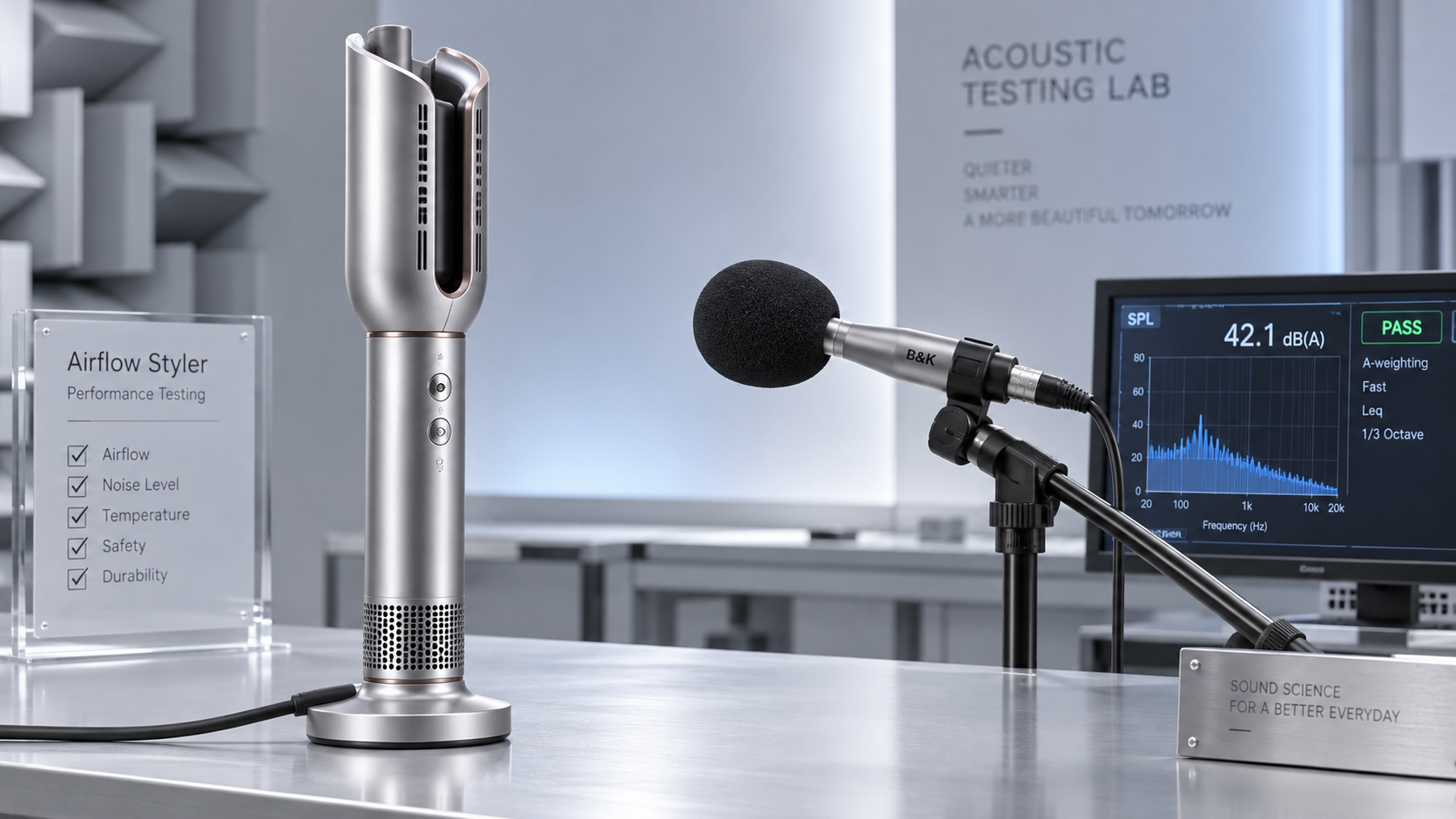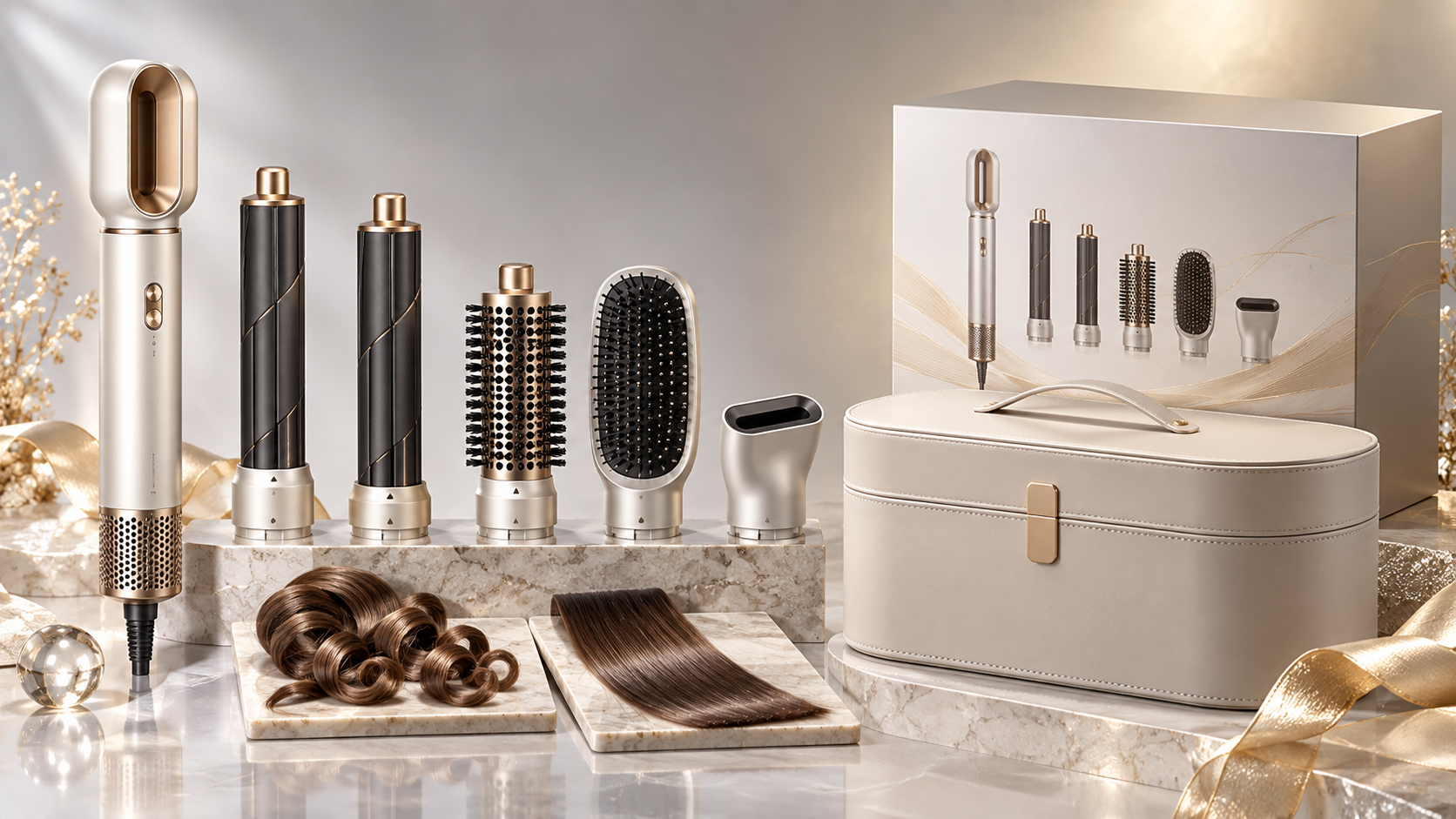
Coanda airflow does not inherently make hair stylers quieter. It controls how air follows a curved surface; noise depends on the complete airflow and motor system.
For technical evaluators, assessing Coanda airflow technology low noise claims requires separating airflow attachment from motor speed, impeller design, turbulence, nozzle geometry, and structural vibration.
A Coanda attachment can change acoustic performance, but the direction and magnitude depend on implementation. Some designs reduce disruptive flow; others introduce whistles or stronger tones.
The useful question is whether a complete styler delivers lower measured noise at comparable styling performance, supported by repeatable tests and clearly defined operating conditions.
What Does the Coanda Effect Actually Change?
In air styling, a jet emerging beside a curved surface can remain attached as it travels around that surface, helping guide hair toward the attachment.
This behavior involves entrainment and a pressure distribution that turns the jet. It enables airflow guided wrapping without establishing any inherent reduction in acoustic output.
Noise reduction becomes possible only when the surrounding design improves relevant conditions, such as limiting separation, avoiding abrupt transitions, or reducing unnecessary pressure losses elsewhere.
Conversely, a narrow discharge slot may require substantial jet velocity. Interactions between that jet, nearby edges, and entrained air can generate broadband noise or tones.
Whether attachment improves acoustic behavior therefore depends on slot dimensions, surface curvature, flow uniformity, operating pressure, and the relationship between the nozzle and upstream components.
Even stable attachment does not eliminate turbulence. A jet can follow a surface while its shear layer continues to generate fluctuations that contribute to audible noise.
Evaluators should distinguish evidence of successful wrapping from evidence of quieter operation. Demonstrating that hair follows the barrel establishes styling functionality, not an acoustic advantage.
A meaningful technical claim connects specific geometry changes to measured sound differences while documenting airflow, thermal conditions, and styling results under the same comparison framework.
Which Components Usually Determine the Noise?
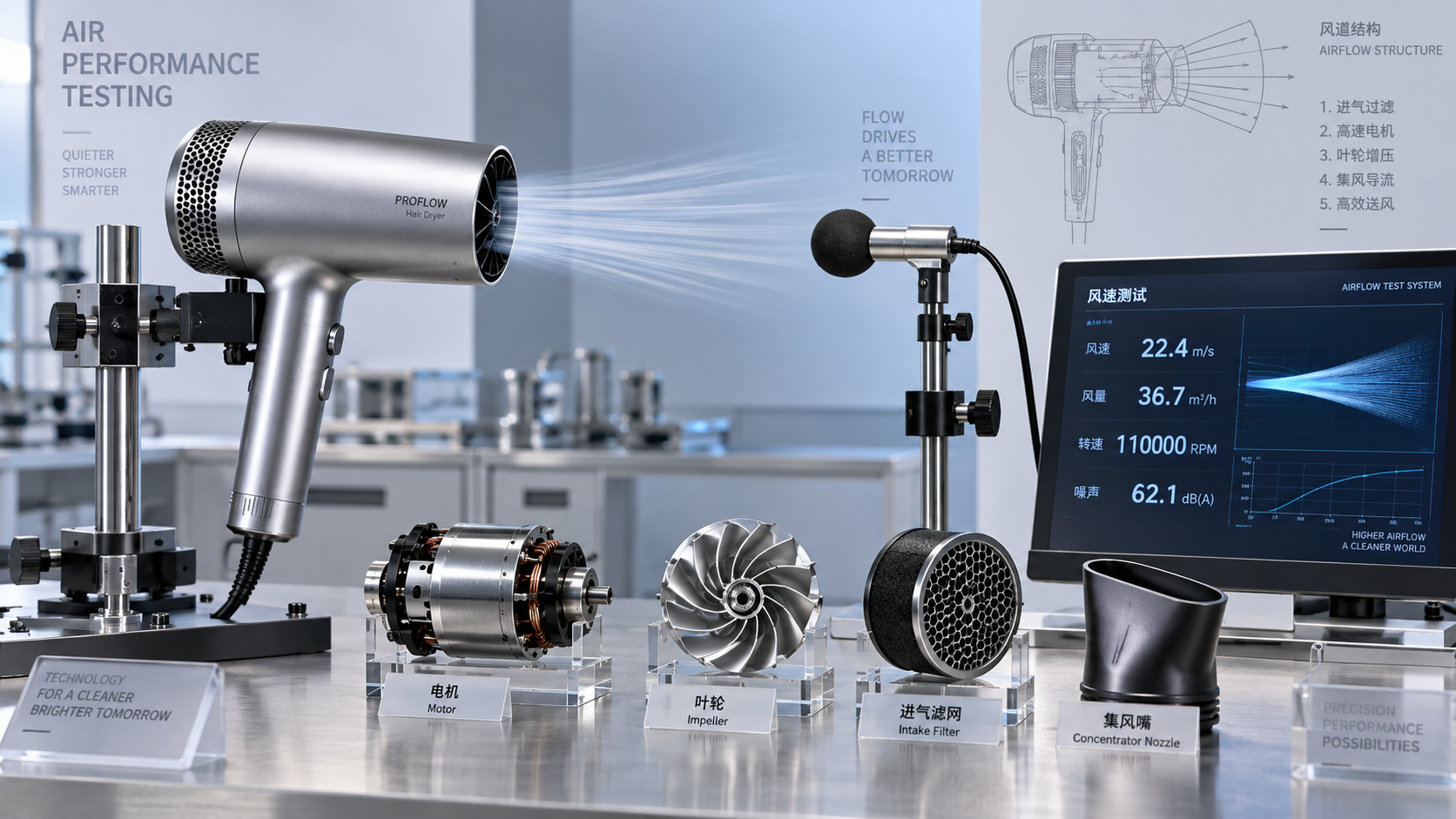
The motor and impeller form one major source group. Rotational imbalance, bearing behavior, electromagnetic excitation, and aerodynamic loading can all contribute to the sound signature.
Impeller blades also produce periodic pressure fluctuations. Blade passing frequency depends on rotational speed and blade count, so changing either can shift prominent tonal components.
Airflow produces another source group through inlet restrictions, blade wakes, sharp bends, leakage paths, and outlet jets. These mechanisms often contribute substantial broadband acoustic energy.
The housing can amplify or transmit these sources. Panel resonances, loose interfaces, and vibration paths may make otherwise similar motor assemblies sound noticeably different in use.
Attachments introduce their own effects through discharge geometry and back pressure. Changing a barrel can alter the operating point of the entire fan and motor assembly.
A brushless motor designation alone therefore says little about finished product noise. Motor quality matters, but installation, control strategy, and aerodynamic integration remain equally consequential.
Hair and user positioning add further variability. Partial inlet obstruction, changing outlet clearance, and different wrapping conditions can modify both the emitted spectrum and perceived loudness.
The practical implication is straightforward: evaluate the assembled appliance with its intended attachment. Isolated motor specifications cannot establish whether the finished Coanda styler is quiet.
What Makes a Noise Comparison Fair?
Start by defining the comparison question. An attachment study, a complete product comparison, and a customer experience assessment require related but different experimental controls and reporting.
To investigate attachment effects, use the same appliance platform where feasible and document changes in motor speed, electrical input, flow, and pressure caused by each attachment.
Holding the speed setting constant is useful, but insufficient. Identical control labels do not guarantee identical rotational speed, outlet flow, or acoustic behavior across products.
For purchasing decisions, compare products delivering equivalent styling outcomes. A quieter appliance that requires substantially longer treatment may offer a weaker practical benefit than expected.
Define those outcomes before testing: wrapping success, curl consistency, drying endpoint, treatment time, and hair temperature may matter more than matching a single airflow measurement.
Use standardized hair tresses with controlled length, mass, texture, and initial moisture. Keep preparation and environmental conditions consistent enough to separate appliance differences from sample variation.
Airflow measurements remain valuable, but outlet velocity alone can mislead. A narrow slot can produce high local velocity while delivering a different total volumetric flow.
Include both a normal use setting and the highest intended operating setting. Quiet performance at minimum power does not substantiate claims covering the full operating range.
Where equivalent performance cannot be established, report the limitation explicitly. Present noise alongside styling time and thermal data so buyers can assess the tradeoff themselves.
How Should Technical Teams Measure Styler Noise?
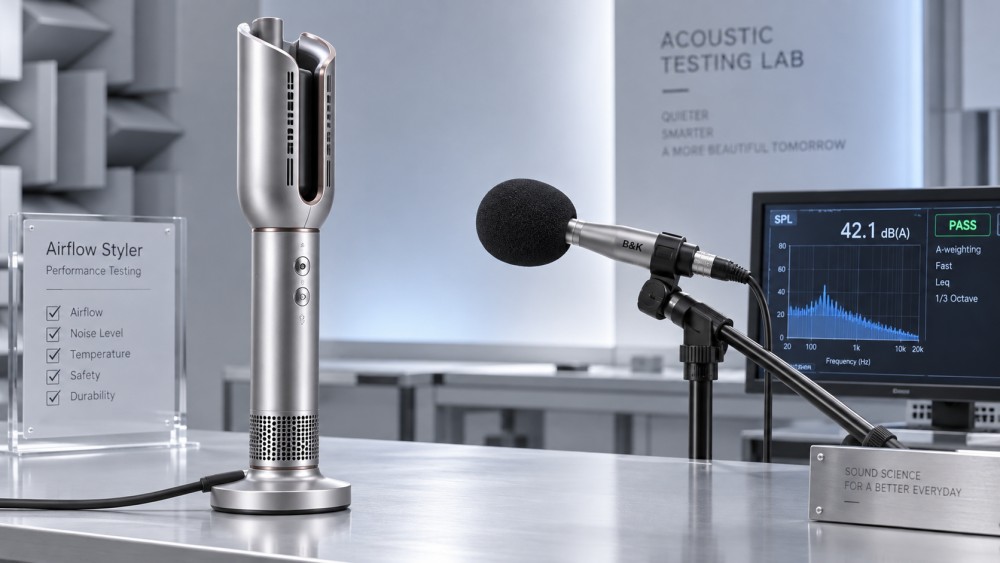
Choose the acoustic quantity before selecting equipment. Sound pressure level describes sound at a measurement position; sound power characterizes source emission under a defined measurement method.
Sound pressure results depend strongly on distance, orientation, and room conditions. Two advertised decibel values are difficult to compare when these details are missing or inconsistent.
For household appliances, review the applicability of IEC 60704-1 and IEC 60704-2-9, including their current editions, product scope, operating conditions, and relevant market requirements before testing.
If using another method, document its measurement environment, instrumentation, positioning, corrections, and uncertainty. An internal development test should be clearly distinguished from a standardized declaration test.
Use calibrated instrumentation with a documented calibration check before and after testing. Confirm that the equipment captures the relevant frequency range without overload or significant distortion.
Control background noise and room reflections according to the chosen method. Background contamination can distort results, especially when evaluating small differences between relatively similar designs.
Prevent microphone exposure to direct outlet airflow. Wind induced microphone noise can create misleading readings that resemble appliance noise but actually arise at the measurement interface.
Measure multiple production units and repeat operating cycles. Report sample count, unit variation, and measurement uncertainty so a small apparent advantage is not mistaken for reliable superiority.
Complement standardized testing with defined user position measurements when comfort matters. Record orientation and distance carefully, because a directional outlet can produce uneven sound exposure.
Which Acoustic Results Matter Beyond a Single Decibel Number?
An A weighted level provides a useful headline metric, but it compresses a complex spectrum into one value and may conceal an objectionable narrow frequency peak.
Request frequency resolved results, using octave or one third octave analysis for broad comparisons and narrowband analysis when investigating whistles, blade tones, or motor related components.
Two stylers with similar overall levels can feel different when one produces a pronounced whine. Tonal prominence may therefore influence user acceptance beyond the headline rating.
Time behavior also matters. Speed hunting, intermittent rattles, and pulsing airflow can be distracting even when a time averaged measurement appears competitive against a steadier product.
A reported three decibel reduction corresponds approximately to halving acoustic power when comparing valid sound power measurements. It does not mean perceived loudness has been halved.
Perceived loudness depends on spectrum, level, duration, and listening conditions. Avoid converting a modest decibel reduction into a percentage quieter without a clearly justified evaluation method.
Where comfort is a product priority, consider controlled listening assessments or appropriate psychoacoustic analysis. Keep those findings separate from standardized emission measurements and explain their conditions.
Treat differences close to combined uncertainty cautiously. A defensible conclusion may be that two products perform similarly, even when their displayed values are numerically different.
Can Lower Noise Compromise Styling Performance?
Reducing motor speed often lowers noise, but it can also reduce airflow or available pressure. Hair capture, wrapping stability, and drying time may deteriorate as a result.
Changing outlet geometry can create similar tradeoffs. A wider slot may reduce local velocity, yet weaken the aerodynamic forces needed to attract and control particular hair sections.
Flow straighteners, smoother passages, and better transitions may improve efficiency, but their benefits depend on placement and geometry. Added components can also introduce losses or tones.
Acoustic treatments require particular care in compact heated appliances. Any material or structure must accommodate thermal exposure, airflow requirements, contamination, durability, and applicable product safety provisions.
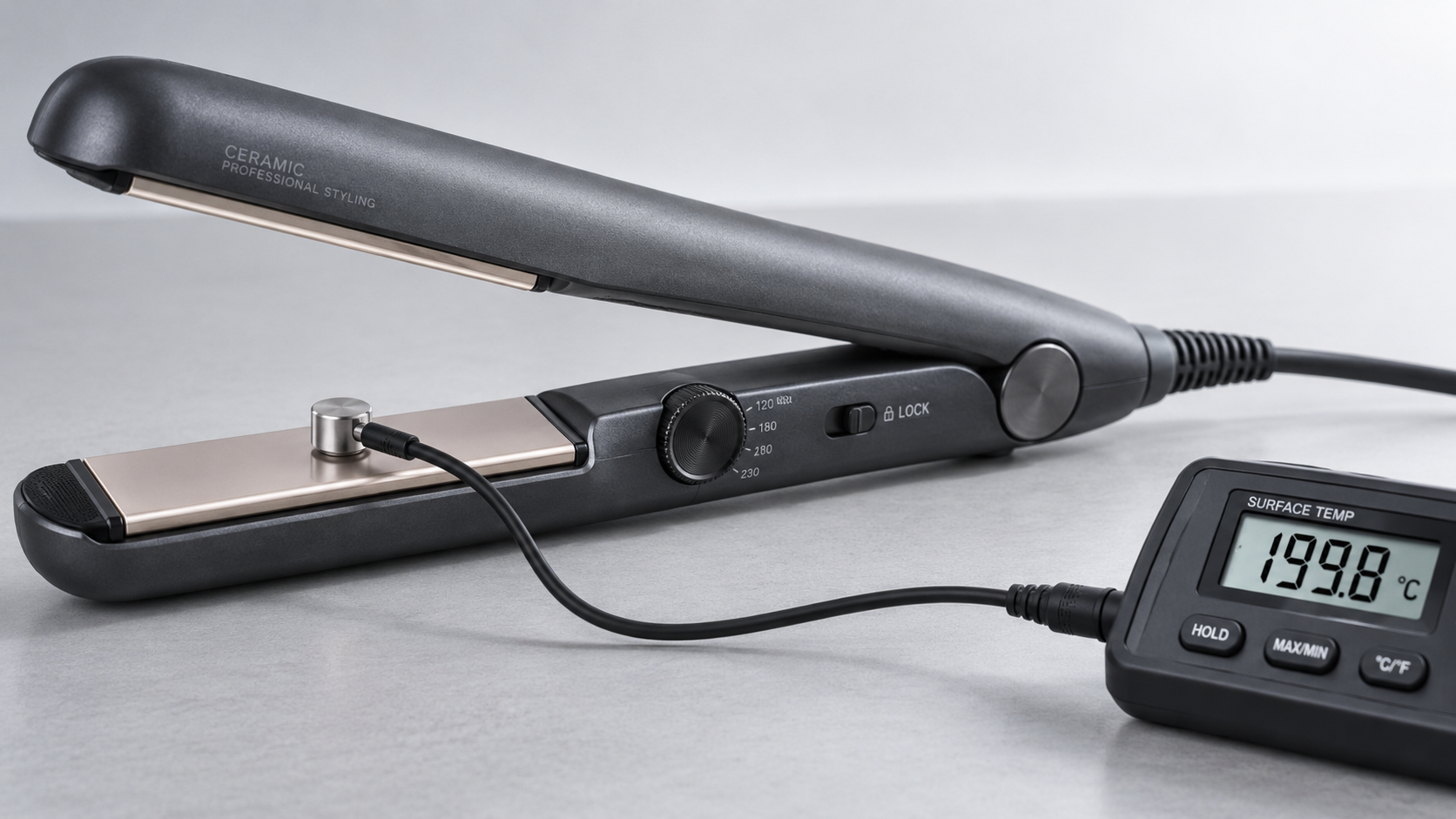
Reduced airflow can also affect temperature regulation. Evaluate actual air and hair temperatures rather than assuming that a lower electrical power reading guarantees gentler styling conditions.
Use a combined scorecard covering noise, wrapping success, treatment time, thermal behavior, power consumption, and reliability. Select priorities according to the intended customer and application.
For example, a modest noise improvement may be commercially useful when styling performance remains stable. The same improvement may be unattractive if treatment time increases substantially.
Development teams should seek operating regions where acoustic improvements persist across useful settings. An isolated quiet setting provides limited value if users routinely need higher power.
What Evidence Should Buyers Request From Suppliers?
Request the complete test report behind any Coanda airflow technology low noise claim. A marketing specification should be traceable to a defined product configuration and measurement method.
The report should identify the model, attachment, voltage, frequency, operating mode, thermal state, measurement quantity, test environment, microphone arrangement, sample count, and relevant uncertainty information.
Ask which reference product supports any reduction claim. Confirm that the reference used comparable settings, accessories, measurement conditions, and styling targets rather than an unusually loud configuration.
Check whether the measured sample represents production hardware. Changes to impellers, motor suppliers, housing materials, seals, or control firmware can alter the final acoustic result.
For OEM qualification, specify an agreed acoustic acceptance method and operating condition. Include tonal or abnormal noise criteria where customer experience requires more than an overall level.
Confirm performance after relevant durability and maintenance evaluations. Filter loading, mechanical wear, and attachment fit changes may affect sound, so initial laboratory measurements provide only one snapshot.
Independent verification is useful when acoustic performance drives a purchasing decision. Prioritize reproducible evidence and production consistency over unsupported claims about proprietary airflow terminology alone.
How Should Evaluators Decide Whether a Coanda Styler Is Quieter?
Coanda airflow is a styling mechanism with possible acoustic consequences. It becomes evidence of quieter operation only when complete product measurements demonstrate a repeatable, relevant improvement.
Base the decision on three linked findings: comparable styling performance, credible acoustic measurements, and acceptable sound quality. None of these findings can substitute for the others.
Approve a low noise claim when its scope matches the evidence, including settings, attachments, reference conditions, and uncertainty. Narrow the wording when the demonstrated benefit is limited.
For manufacturers and procurement teams, the strongest product combines effective hair control with efficient airflow and well managed noise sources, supported by data that survives independent comparison.